Drawing a peeler handle seems simple until you add the grip. You nail the silhouette and the parting lines, but the moment you start adding those tiny perforations or dots, the form often collapses.
When you hand-draw a dot grid on a contoured handle, your hand naturally wants to follow the curve. This usually leads to "drifting." The dots at the top of the handle start wider than the dots at the bottom.
The result is a surface that looks warped. Instead of communicating a high-quality rubberized grip, the sketch looks like it’s melting. The viewer sees the inconsistency before they see the design.
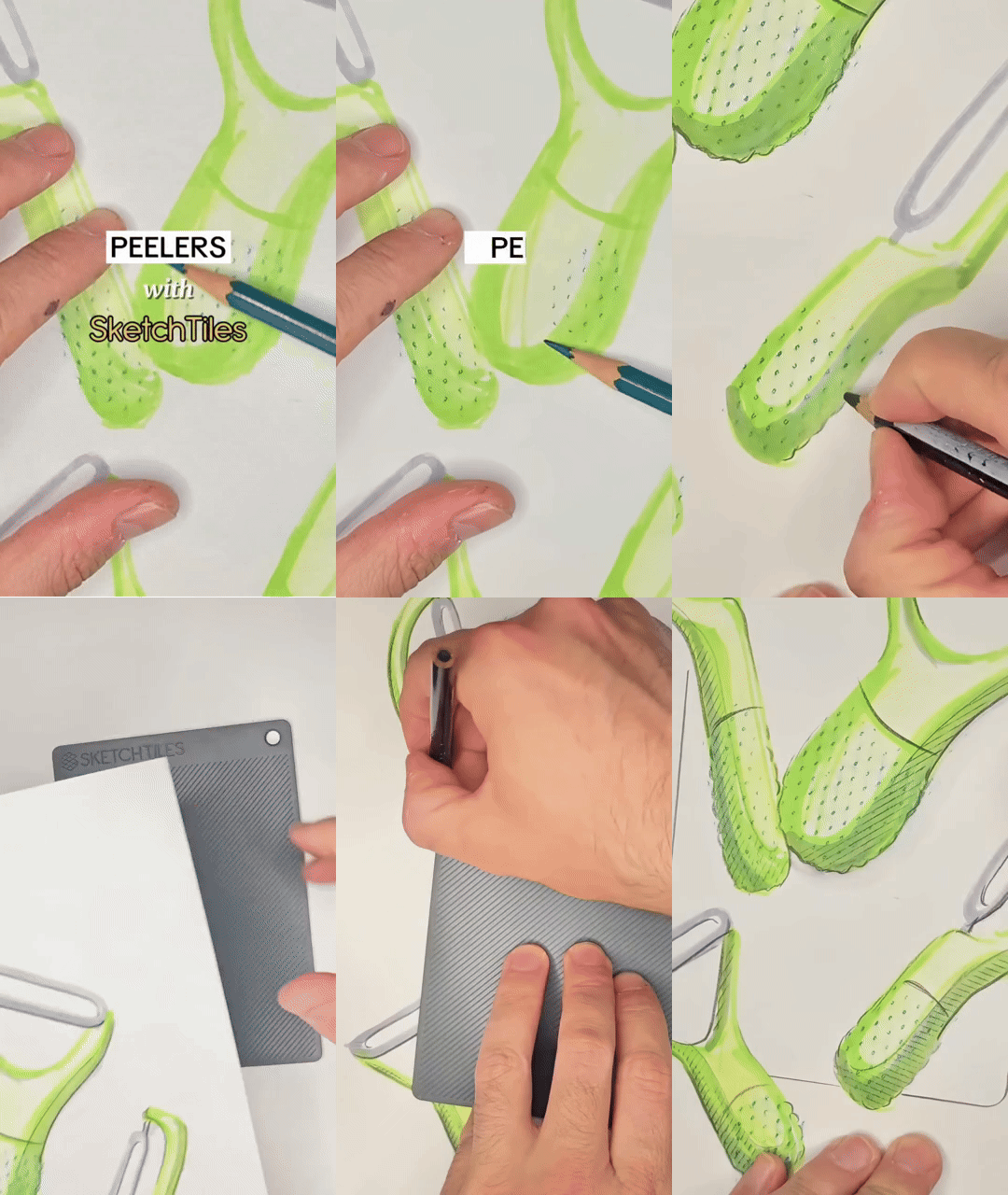
Locking the grid with the Isometric Dot Grid tile
This is where the Isometric Dot Grid tile comes in. Instead of guessing the spacing for every single hole on the peeler’s handle, you lay the tile under the page.
The grid provides a fixed reference point. You aren't just drawing dots; you are following a pre-calculated mathematical layout. This keeps the spacing uniform across the entire surface of the tool, regardless of how the handle twists or turns in perspective.
Why mechanical consistency matters for ergonomics
In industrial design, texture isn't just decoration. On a kitchen tool like a peeler, the grip indicates safety, comfort, and control. It tells the user where to place their thumb.
If the texture in your sketch is inconsistent, the viewer subconsciously perceives the product as poorly manufactured. A perfect grid communicates precision. It tells the client that the ergonomics are intentional and that the material choice is final.
Where to use this
• Power tool handles for impact resistance.
• High-end audio speaker grilles.
• Perforated leather on automotive seating.
• Non-slip surfaces on surgical instruments.
• Ventilation holes on handheld electronics.
• Anywhere a repeated pattern defines the material.
Try this in your next sketch
How does the density of your grip pattern change the perceived "softness" or "tackiness" of the handle material?
What are SketchTiles
SketchTiles are physical texture stencils built for designers, by designers. Place a tile under your page, trace with any pencil or marker, and the pattern transfers onto your sketch. Each set includes four double-sided tiles, etched with eight precise patterns: Diagonal Lines, Crosshatch, Isometric Dot Grid, and Hexagonal Grid.
SketchTiles are available as The Essentials Set and the Essentials Complete Set. Shop on Amazon.
"SketchTiles are physical texture stencils built for designers, by designers. Place a tile under your page, trace with any pencil or marker, and the pattern transfers onto your sketch. Each set includes four double-sided tiles, etched with eight precise patterns: Diagonal Lines, Crosshatch, Isometric Dot Grid, and Hexagonal Grid."
"SketchTiles are available as The Essentials Set and the Essentials Complete Set. Shop on Amazon.




Comments