Vitra x Rimowa Chair: Nailing Corrugated Aluminum with Diagonal Lines
3 days ago
2 min read
Corrugated aluminum is a nightmare for freehand sketching. You start with three perfect lines, but by the tenth, the spacing drifts. The perspective starts to warp in ways you didn’t intend.
When you are sketching a high-end collaboration like the Vitra x Rimowa chair, that drift is fatal. The design relies on mechanical rhythm. If the grooves aren’t perfect, the sketch looks like a drawing of a zebra, not a structural material.
The trap of the converging ridge
Industrial materials like extruded or stamped aluminum require absolute parallelism. In a freehand sketch, your hand naturally wants to arc. This creates "fan-out" where the grooves are wider at the bottom than the top.
The eye picks up on these inconsistencies immediately. It stops seeing a chair and starts seeing a mistake. To represent metal, you need a level of precision that usually requires a ruler and a lot of tedious measuring.
Using Diagonal Lines for structural rhythm
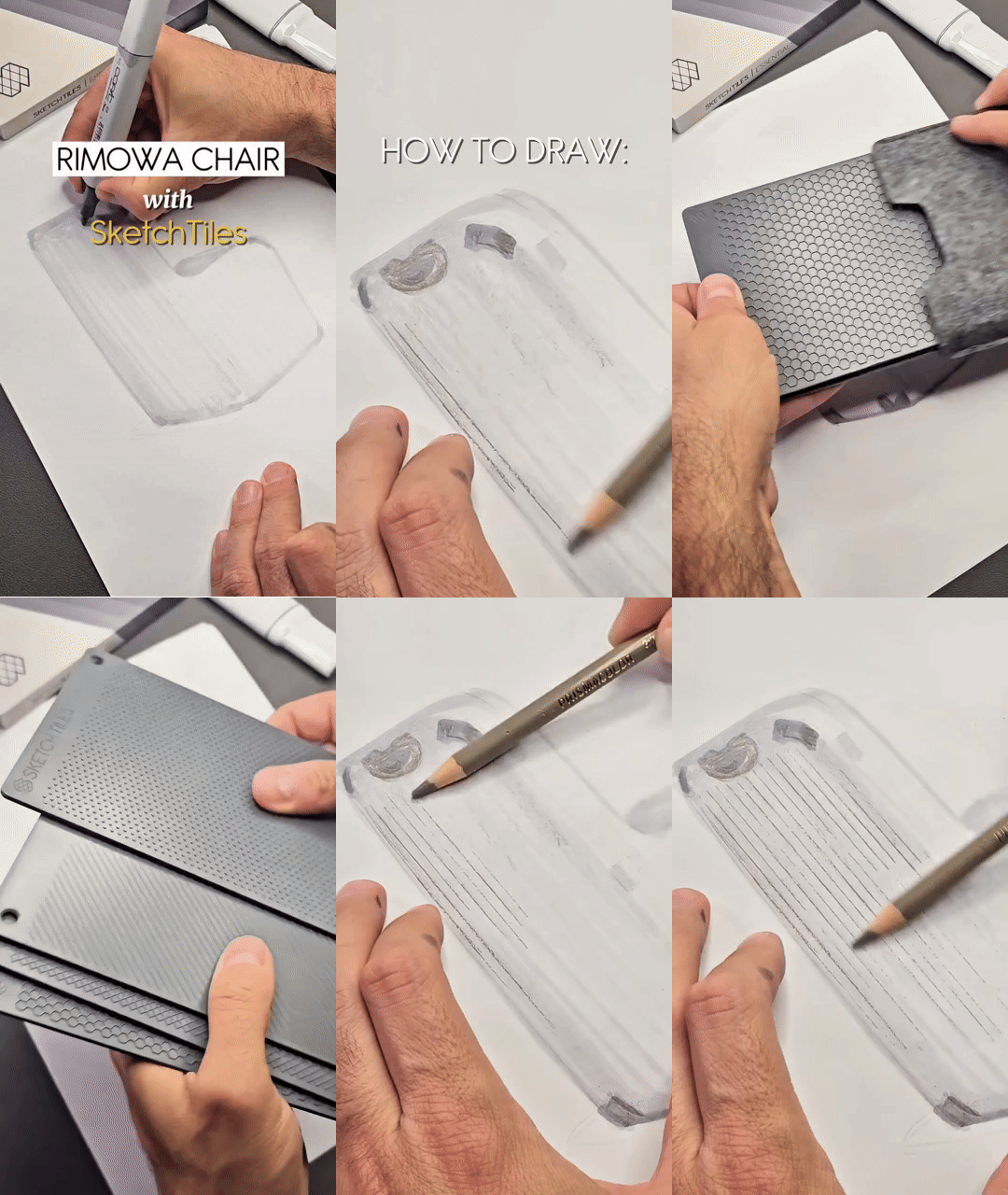
For the Productober finale, I skipped the ruler entirely. I used the Diagonal Lines SketchTile placed directly under the page. By aligning the tile to the perspective of the chair's backrest, the grooves were already mapped out.
The tile handles the spacing. I just focused on the pressure of the marker. This allows you to ghost the lines in quickly, ensuring every "groove" on the Rimowa shell is equidistant.
Consistency defines the material
The principle here is rhythm over detail. The brain identifies "Rimowa" by the frequency of the ridges. If that frequency is constant, the viewer's brain fills in the rest of the material properties.
Using a stencil ensures that the frequency remains constant across the entire surface. Even as the chair curves, the underlying grid of the Diagonal Lines tile keeps the texture grounded in reality. It makes the aluminum look stiff and machined, rather than soft and hand-drawn.
Where to use this
• Heat sinks on high-performance electronics.
• Architectural siding and metal cladding.
• Shipping container walls.
• Automotive radiator grilles.
• Corduroy or ribbed fabric textures.
• Anywhere a repeated pattern defines the material.
Try this in your next sketch
How do you handle the highlight on a metallic ridge without breaking the rhythm of the lines?
What are SketchTiles
SketchTiles are physical texture stencils built for designers, by designers. Place a tile under your page, trace with any pencil or marker, and the pattern transfers onto your sketch. Each set includes four double-sided tiles, etched with eight precise patterns: Diagonal Lines, Crosshatch, Isometric Dot Grid, and Hexagonal Grid.
SketchTiles are available as The Essentials Set and the Essentials Complete Set. Shop on Amazon.




Comments