Large, simple surfaces are often the hardest to sketch. A lampshade is a prime example. It has a massive surface area that needs to communicate material without distracting from the form.
The trap of the manual weave
When you try to hand-draw a crosshatch over a large area, your hand naturally arcs. Lines that should be parallel start to fan out. The density shifts from one side to the other.
On a product like a lamp, this inconsistency reads as a defect. The viewer’s eye catches the "wiggle" in the line before they see the light fixture. You end up spending twenty minutes trying to fix a texture that should have taken two.
One tile, two rotations
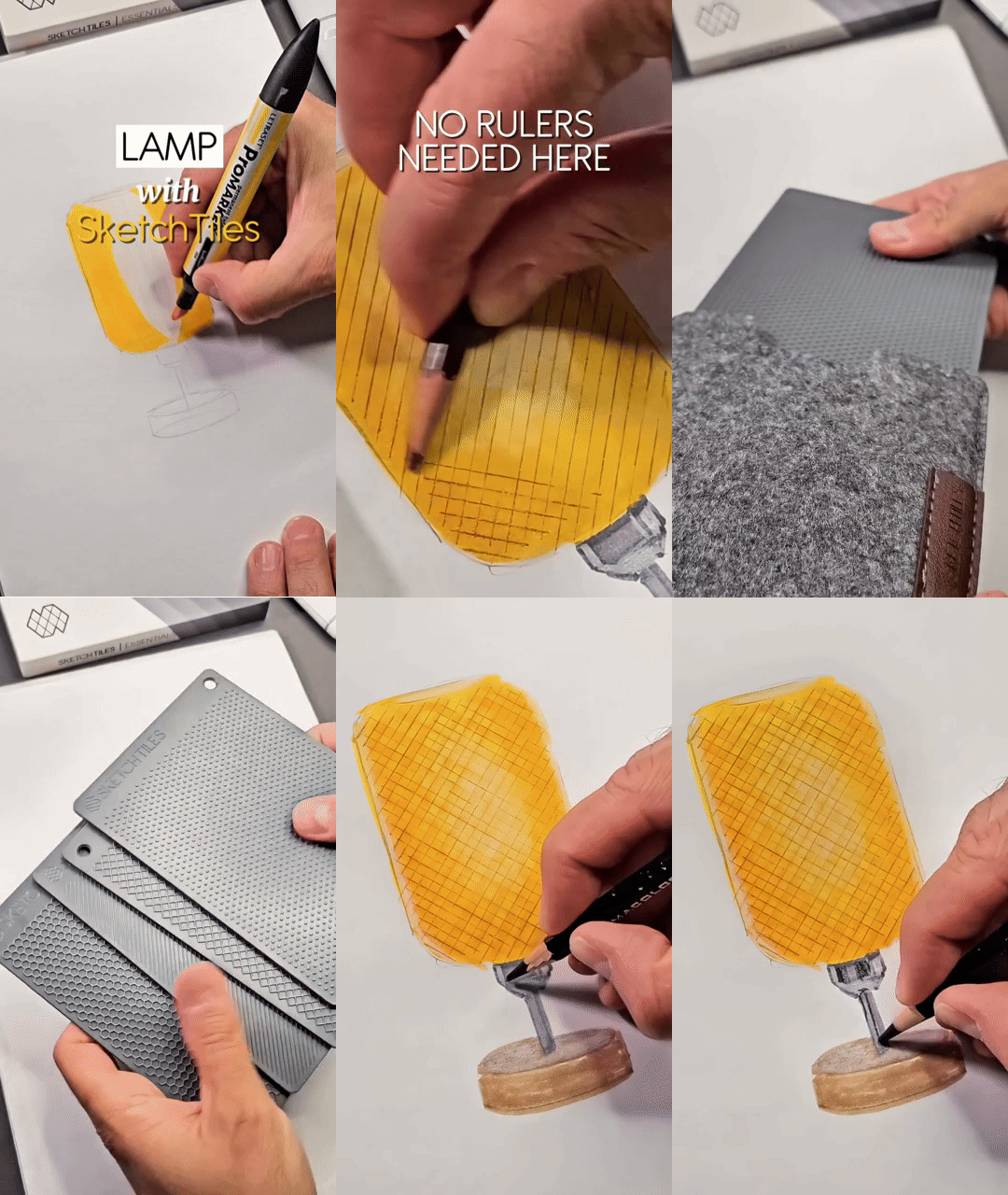
The solution isn't to draw more lines, but to control the intersections. We used the Diagonal Lines Tile for this lampshade. By making one pass, rotating the tile 90 degrees, and making a second pass, you create a perfect technical weave.
This double-pass method ensures that every "diamond" in the crosshatch is identical. There is no measuring. There is no guessing. You get a woven pattern at a scale that is nearly impossible to maintain by hand.
Consistency defines the material
A woven lampshade relies on a rhythmic grid to diffuse light. In a sketch, that rhythm is what tells the brain "fabric" or "mesh" instead of "scratched plastic."
By using a physical stencil, you maintain the same line weight and spacing across the entire curve. The texture follows the silhouette because the tile stays anchored while you move your pen. It creates a professional, manufactured look in seconds.
Where to use this
This double-pass technique works anywhere a technical weave or fine mesh is required:
• Rattan or wicker furniture panels.
• High-end audio speaker cloth.
• Carbon fiber weaves on automotive parts.
• Canvas textures for soft goods and bags.
• Micro-knurling on tool handles.
• Anywhere a repeated pattern defines the material.
Try this in your next sketch
How would your rendering change if you could guarantee every intersection in a crosshatch was perfectly square?
What are SketchTiles
SketchTiles are physical texture stencils built for designers, by designers. Place a tile under your page, trace with any pencil or marker, and the pattern transfers onto your sketch. Each set includes four double-sided tiles, etched with eight precise patterns: Diagonal Lines, Crosshatch, Isometric Dot Grid, and Hexagonal Grid.
SketchTiles are available as The Essentials Set and the Essentials Complete Set. Shop on Amazon.




Comments