Minimalist design is unforgiving. When a product consists of nothing but thin, parallel lines, there is nowhere to hide a mistake. If the third line is a millimeter wider than the second, the entire composition feels broken. The "calm" of the design is replaced by visual noise.
In a piece like Nendo’s Black Lines Chair, the structure is the aesthetic. There is no upholstery or casing to mask a shaky hand. The challenge isn't just drawing straight lines; it is maintaining the mathematical rhythm between them. When you sketch this manually, your eyes naturally compensate for errors, usually making the spacing wider or narrower as you move across the form. This "drift" ruins the structural integrity of the sketch.
Anchoring the rhythm with Diagonal Lines
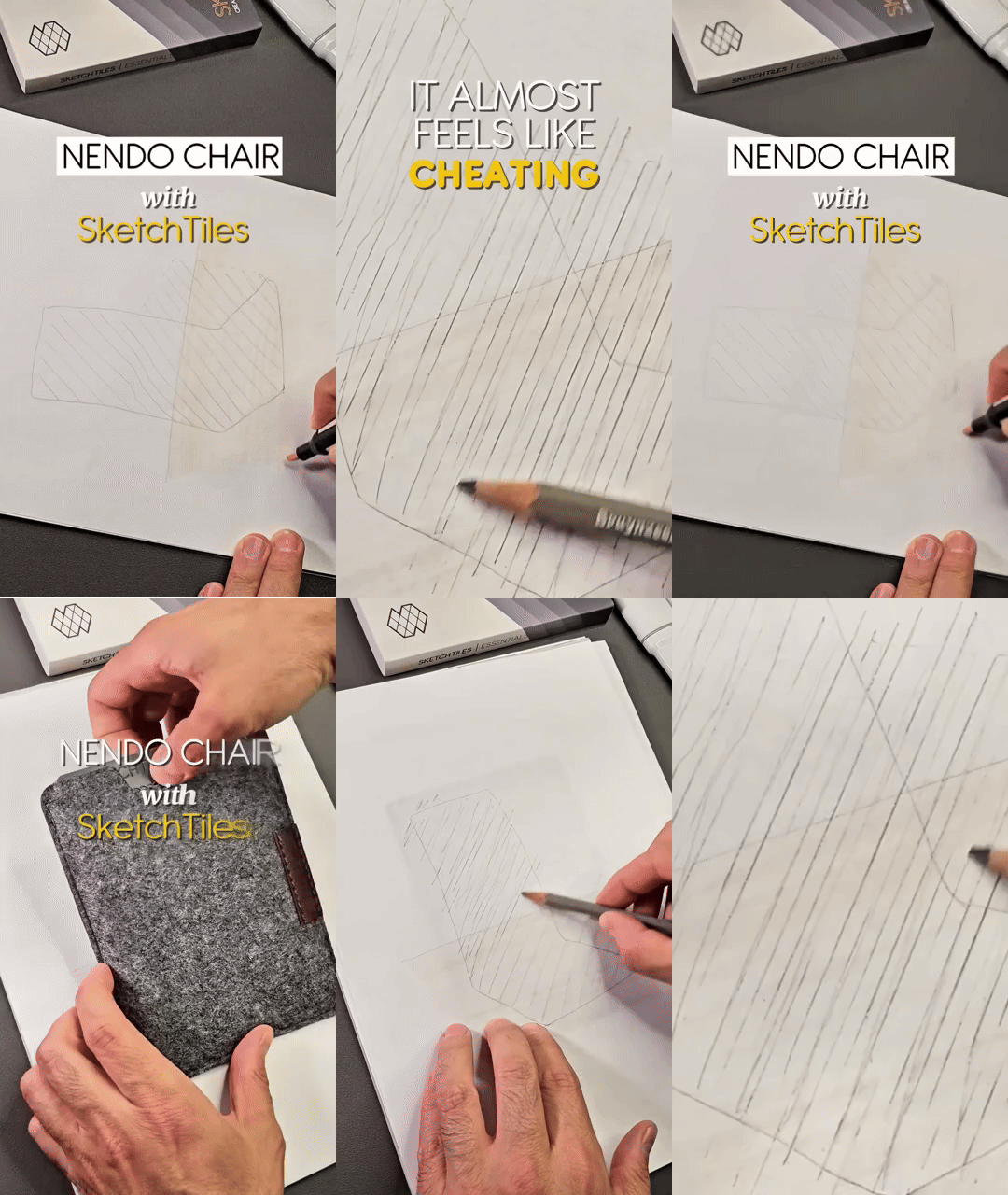
We solved this by using the Diagonal Lines tile as the underlying framework. Instead of free-handing the intervals, we placed the tile beneath the page to set a physical constraint. The tile doesn't just provide a texture; it provides a pre-measured guide. By using these lines as the base, the "math" of the chair was already solved before the first outline was even drawn.
The principle of visual silence
Precision in a sketch creates a sense of intentionality. In Nendo’s work, the beauty comes from the repetition of identical elements. Using a physical guide allows you to focus entirely on the silhouette and the perspective of the chair rather than the tedious task of measuring gaps. When the spacing is perfect, the viewer’s brain stops looking at individual lines and starts seeing the volume of the object.
Revealing the form through the grid
Once the diagonal framework was established, the process became a matter of tracing. We used a black pencil to pull the chair’s form out of the grid. Because the underlying lines were already perfectly balanced, the chair seemed to reveal itself. This approach moves the designer from a state of "construction" to a state of "refinement." It removes the anxiety of the blank page.
Where to use this
This technique isn't limited to furniture. Use the Diagonal Lines tile for heat sinks on electronic components, architectural louvers, or the cooling fins on an engine block. It works perfectly for ribbed plastic textures on consumer tech or the rhythmic slats of a privacy screen. Anywhere a repeated pattern defines the material.
Try this in your next sketch
Can you maintain the exact same gap between twenty parallel lines without using a ruler?
What are SketchTiles
SketchTiles are physical texture stencils built for designers, by designers. Place a tile under your page, trace with any pencil or marker, and the pattern transfers onto your sketch. Each set includes four double-sided tiles, etched with eight precise patterns: Diagonal Lines, Crosshatch, Isometric Dot Grid, and Hexagonal Grid.
SketchTiles are available as The Essentials Set and the Essentials Complete Set. Shop on Amazon.




Comments