Most ski goggle sketches fail at the strap. You nail the lens curvature and the frame geometry, but then you are left with a long, empty band of elastic. If you try to hand-draw that texture, the sketch usually loses its professional edge.
Technical soft goods rely on repetitive manufacturing. A goggle strap is a continuous weave of elastic and nylon. When you draw this by hand, your hand gets tired.
The spacing starts to drift. The angles change as you move across the curve. This inconsistency signals to the viewer that the object is "hand-drawn" rather than "designed."
Anchoring the form with Diagonal Lines
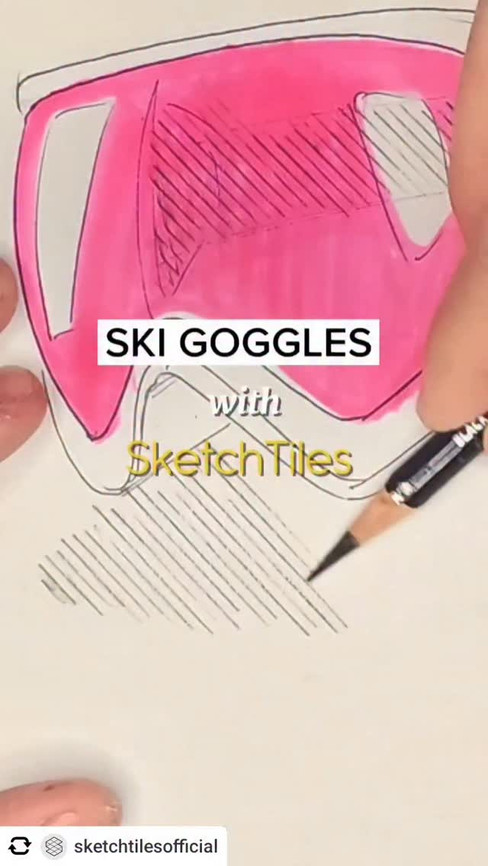
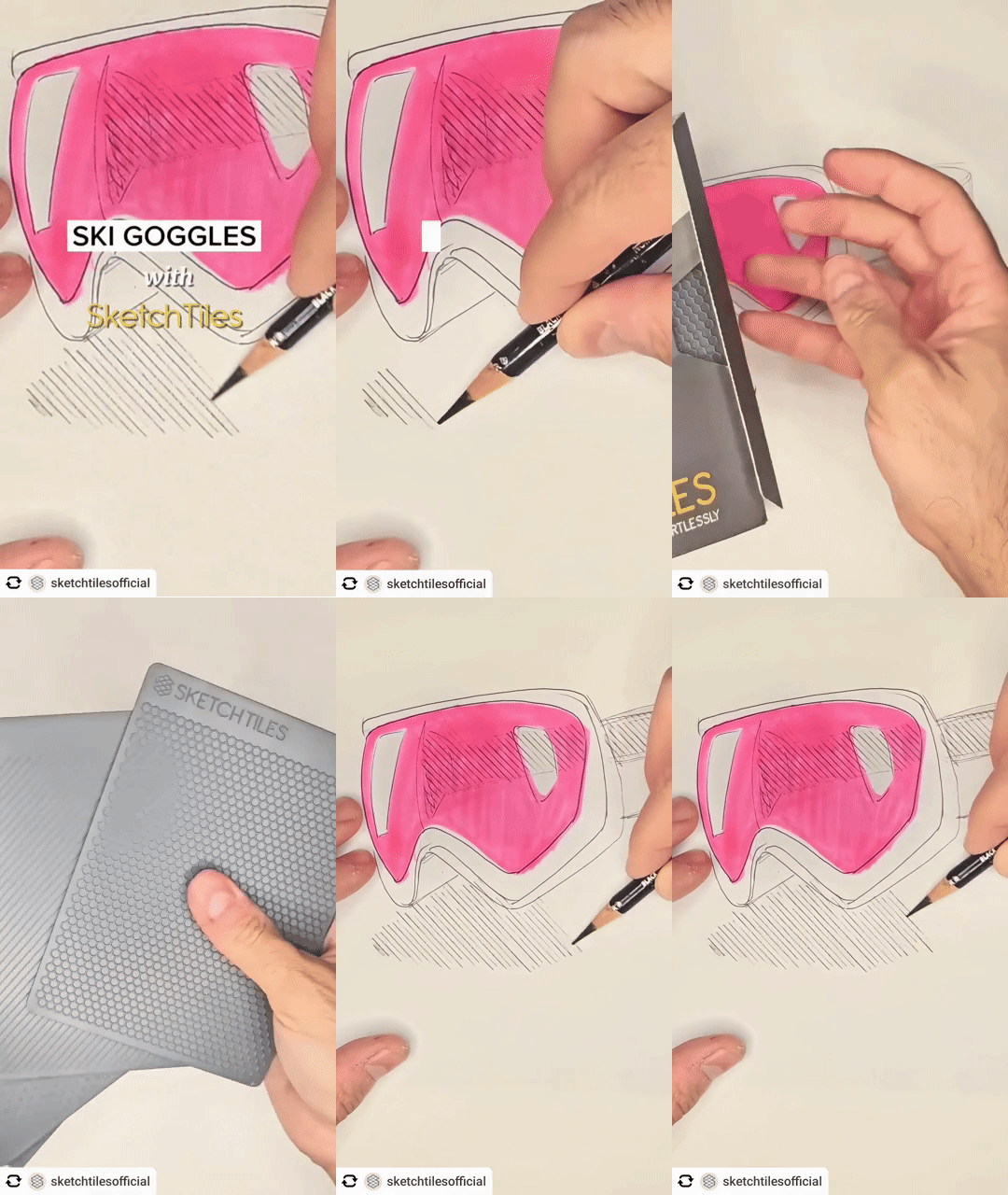
I used the Diagonal Lines tile from the Essentials Set for this strap. Instead of fighting the pen to maintain a 45-degree angle, I placed the tile under the page.
The tile provides a physical guide. It allows for consistent pressure across the entire length of the strap. The texture stays coherent even as the strap wraps around the head form.
Consistency communicates manufacturing
A manufactured product is defined by its precision. When your sketch reflects that uniformity, the viewer stops seeing individual lines. They start seeing a material.
By using a physical stencil, you remove the "wiggle" of the human hand. This allows the focus to stay on the proportion of the goggles and the reflection on the lens. The texture supports the design instead of distracting from it.
Layering texture into the shadow work
I also used the tiles to build out the shadow values. Adding a subtle pattern to a shadow makes the dark areas feel grounded. It prevents the marker ink from looking flat or muddy.
A textured shadow suggests environmental light hitting a surface. It adds a layer of realism that flat color cannot achieve. It makes the goggle feel like it exists in a three-dimensional space.
Where to use this
• Watch bands and wearable tech straps.
• Backpack webbing and adjustment pulls.
• Athletic footwear mesh and knit uppers.
• Camera neck straps and grip surfaces.
• Automotive seatbelts and interior trim.
Anywhere a repeated pattern defines the material.
Try this in your next sketch
How would your workflow change if you stopped worrying about the spacing of a repetitive pattern?
What are SketchTiles
SketchTiles are physical texture stencils built for designers, by designers. Place a tile under your page, trace with any pencil or marker, and the pattern transfers onto your sketch. Each set includes four double-sided tiles, etched with eight precise patterns: Diagonal Lines, Crosshatch, Isometric Dot Grid, and Hexagonal Grid.
SketchTiles are available as The Essentials Set and the Essentials Complete Set. Shop on Amazon.




Comments